Khóa học
IELTS Online
IELTS Online
Giảm đến 18%
Đăng ký ngay
Mục lục [Ẩn]
Bài đọc "The Future of Work" trong cuốn Cambridge 16 Test 1 là một trong những bài kiểm tra toàn diện nhất về kỹ năng Reading IELTS, mang tính học thuật cao. Bài viết này sẽ cung cấp hướng dẫn giải chi tiết từng câu, từ những câu hỏi True/False/Not Given hóc búa đến các dạng Matching phức tạp, giúp bạn ôn luyện Skill Reading hiệu quả và nâng cao band điểm của mình.
The future of work
According to a leading business consultancy, 3-14% of the global workforce will need to switch to a different occupation within the next 10-15 years, and all workers will need to adapt as their occupations evolve alongside increasingly capable machines. Automation – or "embodied artificial intelligence" (AI) - is one aspect of the disruptive effects of technology on the labour market. "Disembodied AI", like the algorithms running in our smartphones, is another.
Dr Stella Pachidi from Cambridge Judge Business School believes that some of the most fundamental changes are happening as a result of the "algorithmization" of jobs that are dependent on data rather than on production- the so-called knowledge economy. Algorithms are capable of learning from data to undertake tasks that previously needed human judgement, such as reading legal contracts, analysing medical scans and gathering market intelligence.
"In many cases, they can outperform humans, says Pachidi "Organisations are attracted to using algorithms because they want to make choices based on what they consider is perfect information, as well as to reduce costs and enhance productivity."
But these enhancements are not without consequences, says Pachidi "If routine cognitive tasks are taken over by AI, how do professions develop their future experts?" she asks "One way of learning about a job is legitimate peripheral participation - a novice stands next to experts and learns by observation. If this isn’t happening, then you need to find new ways to learn."
Another issue is the extent to which the technology influences or even controls the workforce. For over two years, Pachidi monitored a telecommunications company. The way telecoms salespeople work is through personal and frequent contact with clients, using the benefit of experience to assess a situation and reach a decision. However, the company had started using a[n] … algorithm that defined when account managers should contact certain customers about which kinds of campaigns and what to offer them.
The algorithm – usually built by external designers- often becomes the keeper of knowledge, she explains. In cases like this, Pachidi believes, a short-sighted view begins to creep into working practices whereby workers learn through the algorithm’s eyes and become dependent on its instructions. Alternative explorations- where experimentation and human instinct lead to progress and new ideas- are effectively discouraged.
Pachidi and colleagues even observed people developing strategies to make the algorithm work to their own advantage. We are seeing cases where workers feed the algorithm with false data to reach their targets, she reports.
It’s scenarios like these that many researchers are working to avoid. Their objective is to make AI technologies more trustworthy and transparent, so that organisations and individuals understand how AI decisions are made. In the meantime, says Pachidi, 4We need to make sure we fully understand the dilemmas that this new world raises regarding expertise, occupational boundaries and control.
Economist Professor Hamish Low believes that the future of work will involve major transitions across the whole life course for everyone: The traditional trajectory of full-time education followed by full-time work followed by a pensioned retirement is a thing of the past, says Low. Instead, he envisages a multistage employment life: one where retraining happens across the life course, and where multiple jobs and no job happen by choice at different stages.
On the subject of job losses, Low believes the predictions are founded on a fallacy: It assumes that the number of jobs is fixed. If in 30 years, half of 100 jobs are being carried out by robots, that doesn’t mean we are left with just 50 jobs for humans. The number of jobs will increase: we would expect there to be 150 jobs.
Dr Ewan McGaughey, at Cambridge’s Centre for Business Research and King’s College London, agrees that ‘apocalyptic’ views about the future of work are misguided. It’s the laws that restrict the supply of capital to the job market, not the advent of new technologies that causes unemployment.
His recently published research answers the question of whether automation, AI and robotics will mean a jobless future by looking at the causes of unemployment. History is clear that change can mean redundancies. But social policies can tackle this through retraining and redeployment.
He adds: If there is going to be change to jobs as a result of AI and robotics then I’d like to see governments seizing the opportunity to improve policy to enforce good job security. We can “reprogramme” the law to prepare for a fairer future of work and leisure. McGaughey’s findings are a call to arms to leaders of organisations, governments and banks to pre-empt the coming changes with bold new policies that guarantee full employment, fair incomes and a thriving economic democracy.
The promises of these new technologies are astounding. They deliver humankind the capacity to live in a way that nobody could have once imagined, he adds. Just as the industrial revolution brought people past subsistence agriculture, and the corporate revolution enabled mass production, a third revolution has been pronounced. But it will not only be one of technology. The next revolution will be social.
Questions 27-30
Choose the correct letter, A, B, C or D.
Write the correct letter in boxes 27-30 on your answer sheet.
27. The first paragraph tells us about
A. the kinds of jobs that will be most affected by the growth of Al.
B. the extent to which Al will alter the nature of the work that people do.
C. the proportion of the world’s labour force who will have jobs in Al in the future.
D. the difference between ways that embodied and disembodied Al will impact on workers.
28. According to the second paragraph, what is Stella Pachidi’s view of the knowledge economy?
A. It is having an influence on the number of jobs available.
B. It is changing people’s attitudes towards their occupations
C. It is the main reason why the production sector is declining
D. It is a key factor driving current developments in the workplace.
29. What did Pachidi observe at the telecommunications company?
A. staff disagreeing with the recommendations of Al
B. staff feeling resentful about the intrusion of Al in their work
C. staff making sure that Al produces the results that they want
D. staff allowing Al to carry out tasks they ought to do themselves
30. In his recently published research, Ewan McGaughey
A. challenges the idea that redundancy is a negative thing.
B. shows the profound effect of mass unemployment on society
C. highlights some differences between past and future job losses.
D. illustrates how changes in the job market can be successfully handled.
Questions 31-34
Complete the summary using the list of words, A-G, below.
Write the correct letter, A-G, in boxes 31-34 on your answer sheet.
A pressure
B satisfaction
C intuition
D promotion
E reliance
F confidence
G information
The algorithmication of jobs
Stella Pachidi of Cambridge Judge Business School has been focusing on the algorithmication of jobs which rely not on production but on 31……………………
While monitoring a telecommunications company, Pachidi observed a growing 32…………………… on the recommendations made by Al, as workers begin to learn through the ‘algorithm’s eyes’. Meanwhile, staff are deterred from experimenting and using their own 33……………………., and are therefore prevented from achieving innovation.
To avoid the kind of situations which Pachidi observed, researchers are trying to make Al’s decision-making process easier to comprehend, and to increase users 34……………………. with regard to the technology.
Questions 35-40
Look at the following statements (Questions 35-40) and the list of people below.
Match each statement with the correct person, A, B or C.
Write the correct letter, A, B or C, in boxes 35-40 on your answer sheet.
NB You may use any letter more than once.
List of people
A. Stella Pachidi
B. Hamish Low
C. Ewan McGaughey
List of questions
35. Greater levels of automation will not result in lower employment.
36. There are several reasons why Al is appealing to businesses.
37. Al’s potential to transform people’s lives has parallels with major cultural shifts which occurred in previous eras.
38. It is important to be aware of the range of problems that Al causes.
39. People are going to follow a less conventional career path than in the past.
40. Authorities should take measures to ensure that there will be adequately paid work
>>> Xem thêm: Những sai lầm khi luyện IELTS Reading cần tránh và cách khắc phục
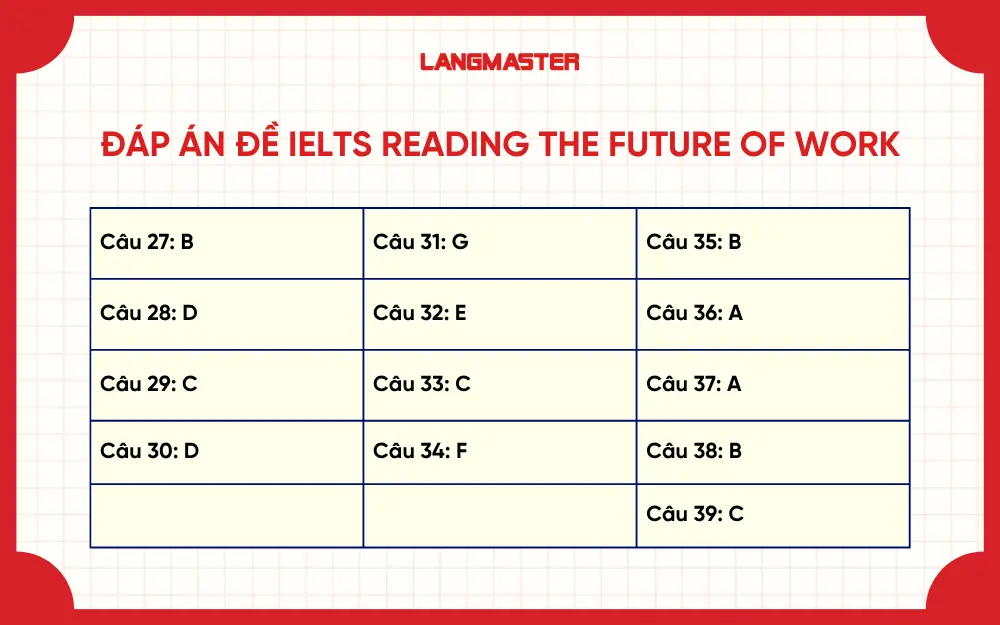
|
Câu 27: B |
Câu 31: G |
Câu 35: B |
|
Câu 28: D |
Câu 32: E |
Câu 36: A |
|
Câu 29: C |
Câu 33: C |
Câu 37: A |
|
Câu 30: D |
Câu 34: F |
Câu 38: B |
|
Câu 39: C |
>>> Xem thêm:
GIẢI THÍCH CHI TIẾT
Câu 27 → Đáp án: B
Câu hỏi: The first paragraph tells us about
Giải thích: Đoạn 1 nói: “3–14% of the global workforce will need to switch occupations … all workers will need to adapt as their occupations evolve alongside increasingly capable machines.”Nghĩa là: mọi người lao động sẽ phải thích nghi vì công việc của họ thay đổi cùng với máy móc thông minh hơn. Không phải nói riêng nghề nào, mà là mức độ ảnh hưởng của AI tới bản chất công việc con người làm.
=> Đáp án đúng: B. The extent to which AI will alter the nature of the work that people do. (Mức độ mà AI sẽ thay đổi bản chất công việc con người làm.)
Câu 28 → Đáp án: D
Câu hỏi: According to the second paragraph, what is Stella Pachidi’s view of the ‘knowledge economy’?
Giải thích: Đoạn 2: Pachidi nói rằng “some of the most fundamental changes are happening as a result of the ‘algorithmization’ of jobs … the so-called knowledge economy.”
→ Cô ấy cho rằng các thay đổi quan trọng nhất đang diễn ra do việc thuật toán hóa các công việc dựa trên dữ liệu. →“Knowledge economy” chính là yếu tố chính đang thúc đẩy sự thay đổi hiện nay trong môi trường làm việc.
=> Đáp án đúng: D. It is a key factor driving current developments in the workplace. (Là yếu tố then chốt thúc đẩy sự phát triển hiện nay của nơi làm việc.)
Câu 29 → Đáp án: C
Câu hỏi: What did Pachidi observe at the telecommunications company?
Giải thích: Đoạn 5–6: “We are seeing cases where workers feed the algorithm with false data to reach their targets.”
→ Nhân viên cung cấp dữ liệu sai cho thuật toán để đạt chỉ tiêu – nghĩa là họ điều chỉnh AI để tạo ra kết quả họ mong muốn.
=> Đáp án đúng: C. Staff making sure that AI produces the results that they want. (Nhân viên đảm bảo rằng AI tạo ra kết quả họ muốn.)
Câu 30 → Đáp án: D
Câu hỏi: In his recently published research, Ewan McGaughey...
Giải thích: Đoạn 11–12: McGaughey nói rằng lịch sử cho thấy thay đổi có thể gây mất việc, nhưng chính sách xã hội có thể giải quyết thông qua đào tạo lại và bố trí lại công việc.
→ Ông đưa ra cách xử lý thay đổi việc làm một cách thành công.
=> Đáp án đúng: D. Illustrates how changes in the job market can be successfully handled. (Minh họa cách những thay đổi trong thị trường việc làm có thể được xử lý hiệu quả.)
Câu 31 → Đáp án: G
Giải thích: Đoạn 2 nói rõ: “jobs that are dependent on data rather than on production – the so-called knowledge economy.”
→ Công việc này phụ thuộc vào data (information).
=> Đáp án đúng: G. information
Câu 32 → Đáp án: E
Giải thích: Đoạn 6: “workers learn through the algorithm’s eyes and become dependent on its instructions.”
→ Họ phụ thuộc (rely) vào AI.
=> Đáp án đúng: E. reliance
Câu 33 → Đáp án: C
Giải thích: Đoạn 6: “Alternative explorations—where experimentation and human instinct lead to progress—are discouraged.”
→ Nghĩa là bản năng, trực giác con người bị kìm hãm.
=> Đáp án đúng: C. intuition
Câu 34 → Đáp án: F
Giải thích: Đoạn 7: “Researchers are working to make AI more trustworthy and transparent so that organisations and individuals understand how AI decisions are made.”
→ Mục tiêu là tăng niềm tin, sự tin tưởng (confidence) vào AI.
=> Đáp án đúng: F. confidence
Câu 35 → Đáp án: B
Giải thích: Đoạn 9: Low nói “The number of jobs will increase: we would expect there to be 150 jobs.” → Nghĩa là tự động hóa không làm giảm việc làm, mà còn có thể tăng.
=> Đáp án đúng: B
Câu 36 → Đáp án: A
Giải thích: Đoạn 3: “Organisations are attracted to using algorithms because they want to make choices based on ‘perfect information’, reduce costs and enhance productivity.” → Các lý do khiến AI hấp dẫn với doanh nghiệp.
=> Đáp án đúng: A
Câu 37 → Đáp án: A
Giải thích: Đoạn 7: “We need to make sure we fully understand the dilemmas that this new world raises…” → Cô ấy nhấn mạnh cần hiểu rõ các vấn đề mà AI gây ra.
=> Đáp án đúng: A
Câu 38 → Đáp án: B
Giải thích: Đoạn 8–9: Low nói “The traditional trajectory… is a thing of the past. Instead, he envisages a multistage employment life...” → Nghĩa là con đường nghề nghiệp tương lai sẽ khác truyền thống.
=> Đáp án đúng: B
Câu 39 → Đáp án: C
Giải thích: Đoạn 12: “Governments should seize the opportunity to improve policy to enforce good job security.” → Chính quyền cần đảm bảo việc làm ổn định, trả lương công bằng.
=> Đáp án đúng: C
>> Xem thêm:
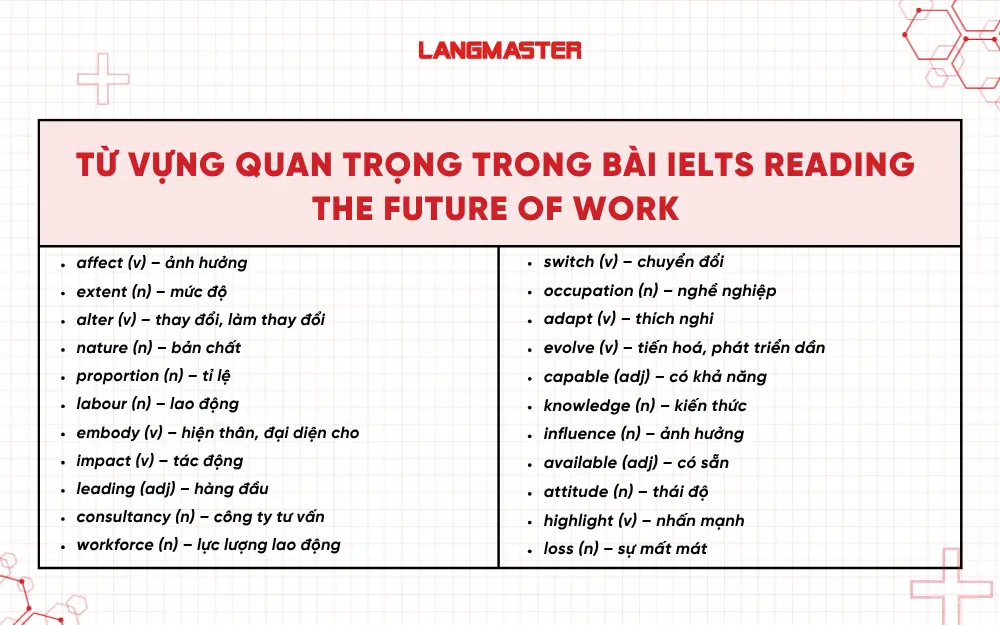
>> Xem thêm: [TỔNG HỢP] TỪ VỰNG IELTS READING THEO CHỦ ĐỀ THƯỜNG GẶP
Phần IELTS Reading luôn là thử thách với nhiều thí sinh, đặc biệt là các dạng bài, chủ đề yêu cầu tư duy phân tích, kỹ năng đọc hiểu chính xác và tốc độ cao. Mỗi dạng bài đều có chiến lược và kỹ thuật riêng, nếu không được luyện tập bài bản, bạn rất dễ mất điểm vào những chỗ không đáng.
Để chinh phục điểm cao Reading IELTS, việc học theo lộ trình rõ ràng, có giảng viên hướng dẫn chi tiết và nhận phản hồi từng bài là cực kỳ quan trọng. Đây cũng là lý do nhiều học viên lựa chọn khóa học IELTS online tại Langmaster, nơi cung cấp:

Đặc biệt: Học viên được HỌC THỬ MIỄN PHÍ trước khi đăng ký chính thức. Đây là cơ hội để bạn trải nghiệm phương pháp giảng dạy và thấy rõ sự khác biệt ngay từ buổi đầu.
KẾT LUẬN: Như vậy, Langmaster đã vừa cùng bạn phân tích và giải chi tiết đề IELTS Reading Cambridge 16 Test 1 về chủ đề The Future of Work. Bài viết đã chỉ rõ các kỹ năng cần thiết để tìm thông tin, nhận biết từ khóa và áp dụng chiến lược đọc hiểu hiệu quả. Hy vọng những kiến thức này sẽ giúp bạn tự tin hơn khi làm bài và cải thiện điểm số Reading IELTS. Chúc bạn học tập hiệu quả và đạt kết quả cao trong kỳ thi IELTS sắp tới!



Các dạng bài phổ biến và tiêu chí chấm điểm IELTS Reading chi tiết nhất: Multiple Choice, Matching Information, Matching Headings,... và hướng dẫn chiến lược làm bài hiệu quả

Những sai lầm khi luyện IELTS Reading bao gồm: dịch từng từ, đọc hết cả bài, không đọc câu hỏi trước, không quản lý thời gian, không nắm vững kỹ năng paraphrase, viết sai chính tả
![Giải đề IELTS Reading: A brief history of humans and food [full answers]](https://langmaster.edu.vn/storage/images/2025/09/20/a-brief-history-of-humans-and-food-ielts-reading-answers.webp)
Giải đề thi IELTS Reading “A brief history of humans and food” kèm full đề thi thật, câu hỏi, đáp án, giải thích chi tiết, và từ vựng cần lưu ý khi làm bài.

Tổng hợp IELTS Reading tips hay nhất giúp bạn đọc nhanh, nắm ý chính và xử lý thông tin chính xác, tự tin đạt điểm cao trong kỳ thi IELTS.
![Giải đề IELTS Reading: The importance of law [Full answers]](https://langmaster.edu.vn/storage/images/2025/09/22/55.webp)
Giải đề IELTS Reading “The importance of law” kèm đáp án chi tiết, từ vựng quan trọng và bí quyết luyện thi hiệu quả để nâng cao band điểm.




Hơn 16 năm kinh nghiệm, đào tạo thành công 800.000+ học viên
Phương pháp giảng dạy hiện đại, học viên tiến bộ rõ rệt
Lộ trình học chuẩn quốc tế, phù hợp với nhu cầu thực tiễn
Giáo viên đạt chuẩn Quốc tế với chất lượng top đầu thị trường, giàu kinh nghiệm
Học online linh hoạt, cam kết đầu ra bằng văn bản